

Melting ice sheets means rising sea levels.
Exploring the Global Consequences of Melting Ice Sheets and Glaciers
International Year of Glaciers' Preservation
Glaciers are vanishing at record rates, destabilizing water supplies, amplifying extreme weather, and accelerating the climate crisis. That’s why UNESCO and the WMO have declared 2025 the International Year of Glaciers’ Preservation (IYGP)—a global call to action to protect these frozen reservoirs before it’s too late.

REPORT CARD
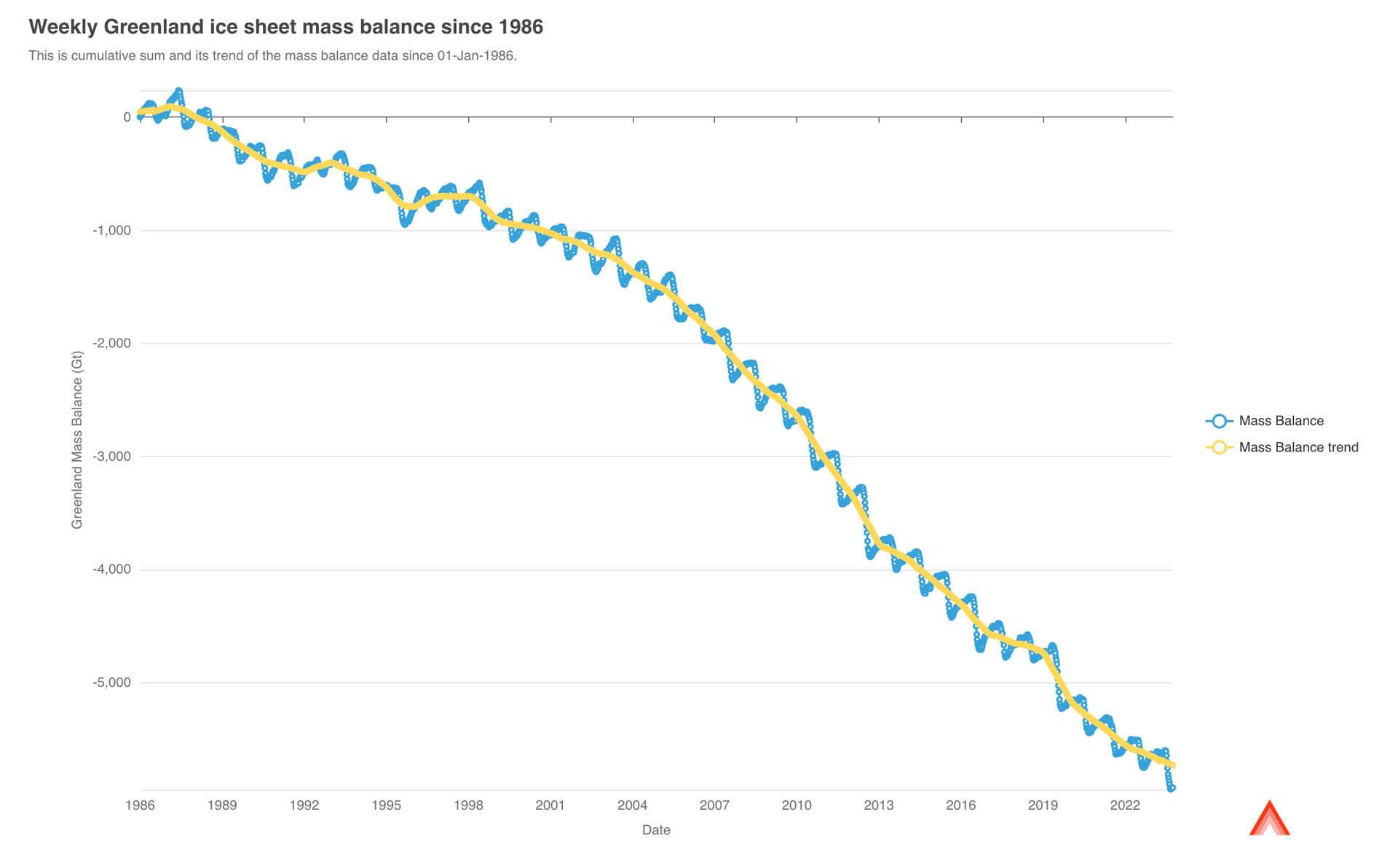
THE MASSIVE GREENLAND ICE SHEET IS SHRINKING
Within the last three decades, the Greenland Ice Sheet—among the largest storehouses of frozen freshwater on Earth—has lost almost 5 trillion tonnes from melting and runoff caused by climate change.
That’s equal to about 13.5 millimeters in sea-level rise. Losses from other ice masses and thermal expansion of the ocean doubles this figure. But this is just the beginning: Greenland ice was in balance with climate in the 1990s and its ice deficit is now accelerating.

THE WATSON RIVER

A WARMER ARCTIC UNDERMINES ITS VAST ICE SHEETS.
ANTARCTICA IS THE LARGEST RESERVOIR OF ICE ON EARTH.

MELTING ICE SHEETS MEAN HIGHER SEAS.
The Greenland Ice Sheet contains the equivalent of 7.4 metres of sea level rise. It is now the largest contributor to global sea level rise at up to 1.4 mm per year and Greenland’s ongoing deglaciation will massively disrupt coastal communities across the world.
Breaking research by Box, Hubbard et al. (2023) shows that Greenland’s ice sheet is being dismantled both internally and externally by a variety of simultaneous processes. We now know that Greenland’s contribution to global sea level rise is significantly greater than models have forecasted and is primed for catastrophic coastal flooding for more than a billion people around the world–the vast majority of whom are unprepared.
AR6 SUMMARY
Greenland’s great ice sheet is dwindling to meltwater
- Over the next century, the dwindling Greenland Ice Sheet is expected to add one to 10 millimeters (0.04-0.39 inches) of sea-level rise even if CO2 emissions are greatly reduced. Oceans will rise 4–13 millimeters (0.16-0.51 inches) with moderate emissions and 9–18 millimeters (0.35-0.71 inches) if emissions continue to climb.
- Rising seas could be far higher if the projected pace of Greenland’s disappearance exceeds expectations.
- Fresh water from the melting Greenland Ice Sheet is expected to slow the main North Atlantic Ocean current, interfering with the ocean’s usual delivery of tropical warmth to northern climates.
- IPCC scientists say humans are “very likely” behind the surface melting of the Greenland Ice Sheet over the past two decades, and ice loss will continue over the 21st century as CO2 emissions climb.
Antarctic ice loss is accelerating.
AR6 states that between 1992 and 2020, Antarctica lost approximately 2670 Gt mass of ice. That is equivalent to 7.4 mm global mean sea level rise. This mass loss has been dominated by the acceleration, retreat and thinning of the principal West Antarctic outlet glaciers over recent decades. These losses were driven by the melting of ice shelves by warm ocean waters.
The limit of stability for the West Antarctic Ice Sheet is thought to be around 1.5°C–2°C. Total collapse of the West Antarctic Ice Sheet is projected over millennial timescales in a +2°C world. This alone would add as much as 5 m to global sea level.


