

Latest News
A thawing Arctic landscape releases more greenhouse gas.
Uncovering the Climate Impact of Thawing Permafrost and Rising Arctic Fires
Thawing permafrost and intensifying Arctic wildfires are unleashing vast greenhouse gases, accelerating global warming. With 18 billion tonnes of CO2 per 1°C rise and 142 million tonnes from fires annually, this feedback loop threatens our climate. Explore the data and trends driving this urgent environmental challenge.
REPORT CARD
VAST AREAS OF ARCTIC PERMAFROST ARE THAWING.
The Arctic’s permanently frozen ground - home to enormous amounts of trapped carbon—is warming quickly as the global climate changes. The thawing soil is expected to release about 18 billion tonnes of CO2 for every 1°C of warming into the future. and has the potential to unleash vast amounts (200 Peta-tonnes) of methane directly into the atmosphere - a potent greenhouse gas that is currently frozen as clathrates within soil, wetlands and subglacially across the Arctic.
Research by Woodwell indicates that emissions from permafrost thaw this century could be on par with continued emissions by Japan or as high as continued emissions by the United States (Natali, Rogers, 2021). This means that permafrost thaw emissions could use up 25-40% of the remaining carbon budget to stay below 2°C (Natali, Rogers, 2021).
Research by Woodwell indicates that emissions from permafrost thaw this century could be on par with continued emissions by Japan or as high as continued emissions by the United States (Natali, Rogers, 2021). This means that permafrost thaw emissions could use up 25-40% of the remaining carbon budget to stay below 2°C (Natali, Rogers, 2021).

Latest News
See Full Data
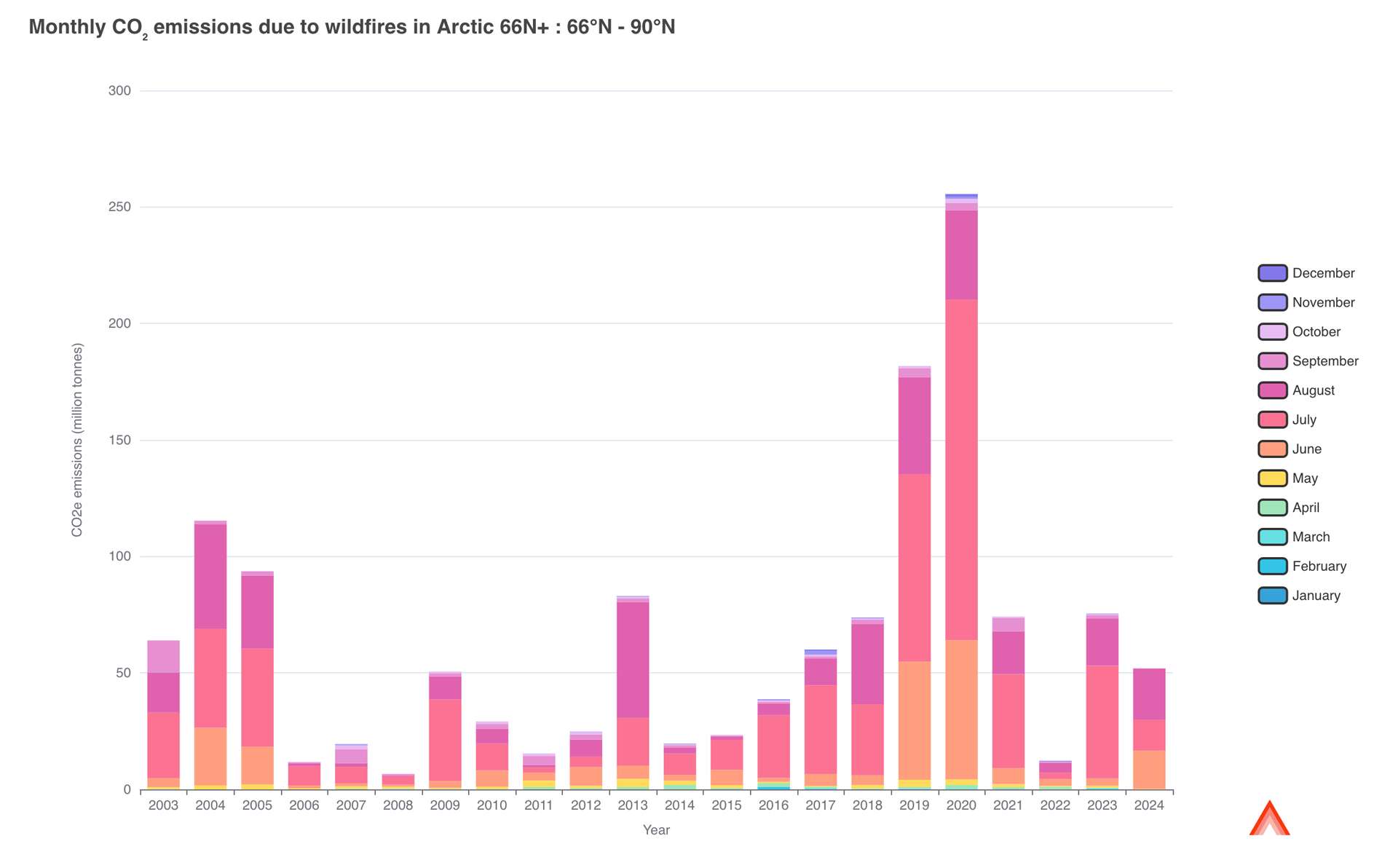
RARE ARCTIC WILDFIRES ARE BECOMING MORE COMMON.
The Arctic - now heating up at least 4 times faster than the world as a whole - is seeing more frequent and more intense fires across larger areas, sending about 142 million tonnes of carbon into the sky every year. That’s close to the total annual greenhouse gas emissions of the Netherlands.
Latest News
See Full Data
AR6 SUMMARY
The Assessment Report of the UN’s Intergovern-mental Panel on Climate Change (IPCC) is issued in three parts by hundreds of international scientists every seven years. Widely considered the authoritative word on what’s up with climate and weather around the world, Part 1 of the sixth report (AR6) was released in early August 2021.
As permafrost thaws, a carbon vault is unlocked.
The Arctic’s permanently frozen ground is thawing quickly and, thanks to climate-affected warmer, dryer soil, is increasingly prone to fires, according to the UN’s latest special report on climate science. Half of all Arctic land (not including land under permanent ice sheets and glaciers) is frozen as permafrost, but, thanks to climate change, the frozen ground has warmed by more than a quarter of a degree Celsius every year between 2007 and 2016. For every 1°C warming through this century, scientists expect thawing permafrost to release about 18 billion tonnes of carbon into the atmosphere, changing the climate even faster.
- Temperatures in permanently frozen Arctic ground between 10 to 20 meters deep have reached record highs in recent decades.
- The volume of frozen soil within the upper three meters of this permafrost ground is expected to decrease by about 25 percent for every 1°C of global warming into the future.
- Thawing permafrost in mountainous areas is expected to make slopes less stable and rockslides more common.
- Weather conditions favourable to wildfires are expected to occur more often in many regions of the world as the planet warms.
- So-called low-probability “unprecedented extremes,” such as wildfires in parts of the Arctic, are expected to become less rare.
What You Can Do?
Join the Fight Against World's Climate Crisis
SubscribeDiscover global climate challenges and the Polar connection
Spread the WordShare this page to raise awareness

