
March 27, 2026

Latest News
Arctic Ice (2026) by Kristaps Ungurs on Unsplash
Arctic sea ice has reached another record low winter maximum, according to scientists at the National Snow and Ice Data Center (NSIDC). In 2026, Arctic winter sea ice extent peaked at 14.29 million square kilometres — statistically tying with 2025 for the lowest maximum in the 48-year satellite record history and about 8% below the 1981–2010 long-term average (equivalent to roughly 1.2 million square kilometres less ice than typical winter conditions, an area about the size of South Africa).
This is a critical climate signal.
“Arctic sea ice is a simple and visible barometer of climate change.
Significant change in the Arctic is a particularly large global risk because the Arctic has a fundamental impact on our planetary operating system – what happens in the Arctic will affect all of us.”
– Says Professor Gail Whiteman, Executive Director, Arctic Basecamp in Arctic Focus
The winter maximum marks the point at which Arctic sea ice stops growing and begins to melt. It shows how much ice the Arctic is able to rebuild during the cold season. When that peak is low, the ice pack is typically thinner, younger and more vulnerable.
That matters because the winter maximum helps set the conditions for the melt season ahead. A low maximum gives sea ice a head start on spring and summer loss, increasing the risk of a very low summer minimum.
Taken together, the winter maximum and summer minimum reveal a deeper pattern: the Arctic is not only losing more ice in summer, it is recovering less in winter.
This is not just a polar trend. Sea ice helps regulate the Earth’s climate by reflecting sunlight back into space. As it declines, darker ocean water absorbs more heat, accelerating Arctic warming and reinforcing further ice loss.
The result is a more unstable climate system, with growing risks far beyond the Arctic — including rising sea levels, disrupted weather patterns and broader economic and societal impacts.
The Arctic is not just melting in summer. It is losing its ability to recover in winter. That is a global risk.
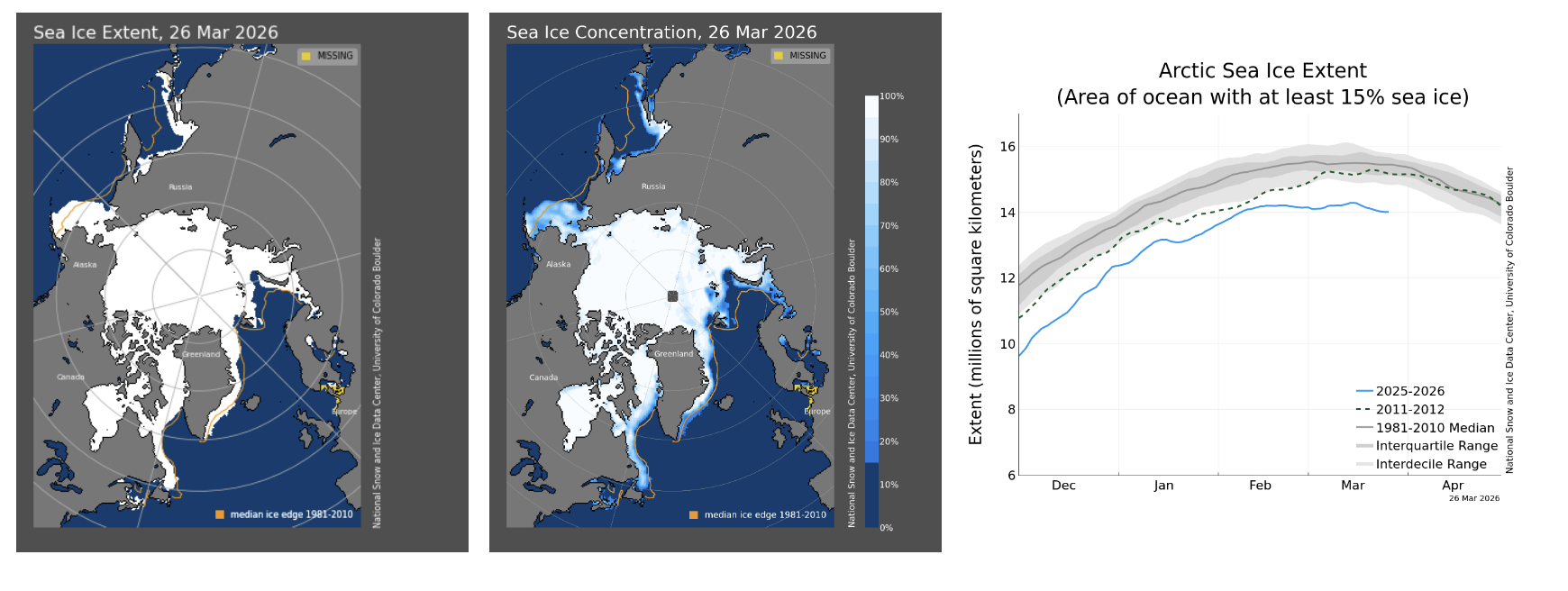
Further information and visuals available at https://nsidc.org/sea-ice-today
What You Can Do?
Join the Fight Against World's Climate Crisis
SubscribeDiscover global climate challenges and the Polar connection
Spread the WordShare this page to raise awareness
Read More From the Polar Change Category
- Latest News
Caption Text Opposed in Principle, Permitted by Law: the EU and Arctic Drilling
On the 20th of October 2026, the European Union published a new Arctic strategy, dropping its earlier commitment to... - Latest News
Caption Text Arctic Shipping Boom Shows the Unequal Costs of a Warming Arctic
Shipping through the Arctic is reaching record levels as declining sea ice makes the Northen Sea Route easier to navigate. Moreover, disruption... - Latest News
Caption Text Record-Low Polar Sea Ice Is a Warning Sign for the Whole Planet
Sea ice at both poles has reached unusually low levels in 2026, according to the National Snow and Ice... - Latest News
Caption Text Why Is It Almost 34°C Near the Arctic Circle?
Temperatures across northern Russia, near the Arctic Circle, have recently exceeded 32°C! Some locations have reached levels more commonly associated with summer heat in much... - Latest News
Caption Text Antarctica’s Missing Sea Ice
An area of Antarctic winter sea ice roughly the size of France – around 650,000 km² – failed to... - Latest News
Caption Text What’s Happening to Antarctic Sea Ice – and Why It Matters Where You Live
Antarctica lost an area of sea ice roughly the size of Greenland in 2023. Scientists now warn the continent...


All Polar Change posts
